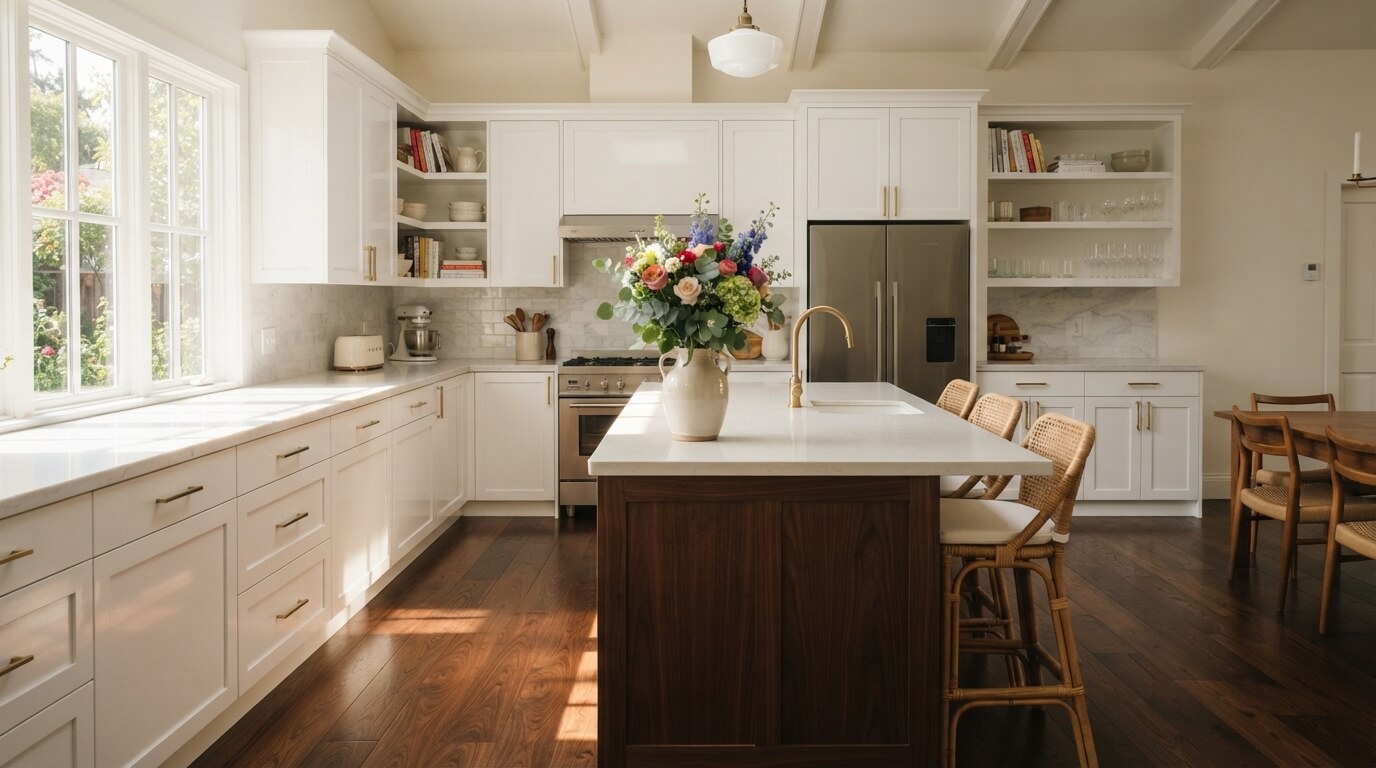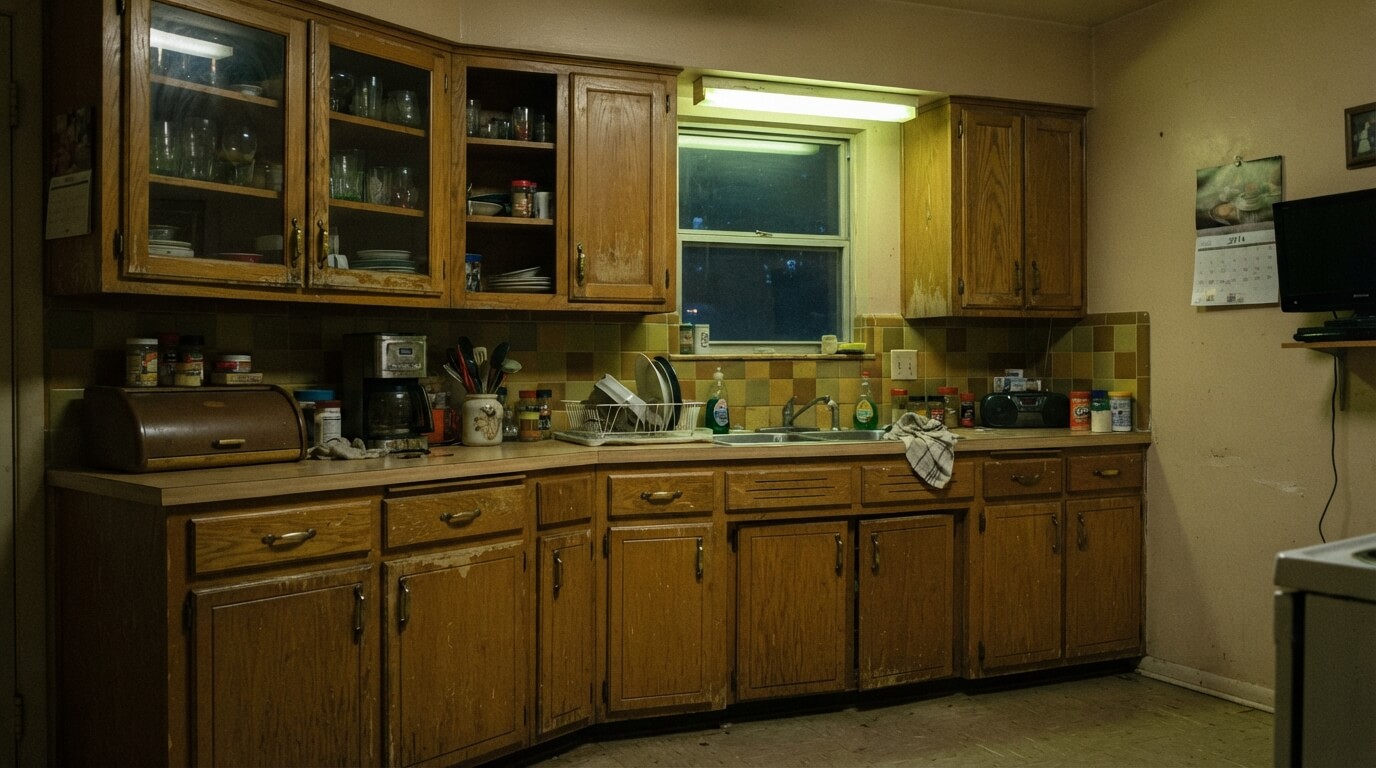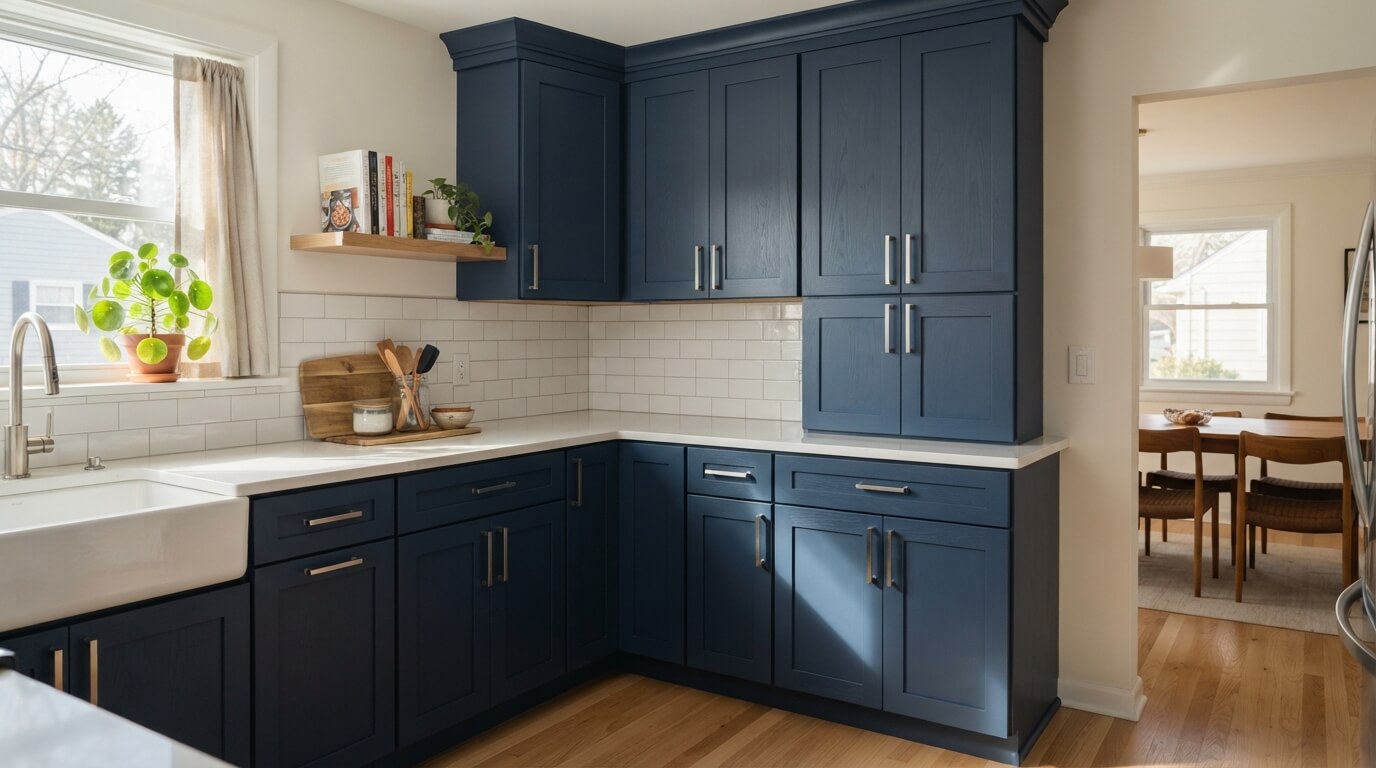
You’ve looked at the same honey oak for twenty years and you’re finally ready to have it painted white. Then you read one thread too many. Somebody painted theirs and the grain came right through, and now you’re picturing a kitchen that reads as white paint over oak from across the room.
That worry holds up a lot of kitchens. One homeowner wrote, “I was so worried about the grain showing through and put off painting my cabinets for 4 years.” The real answer is less bad than the worry. It’s also a yes, with a couple of things you get to decide.
Yes, you’ll see some of it, and here’s how much
Will oak cabinets show grain when they are painted?
Yes, unless the grain is filled before the paint goes on. Oak has an open grain, which means the surface is covered in small pores, and paint follows those pores instead of filling them. A painted oak door keeps the grain as a fine texture, and it shows most in a light color with light coming across it from the side.
A reply on one home forum got it into nine words: “You will still see the grain through your paint.” The orange is gone once the primer and topcoats are on, so color is the part you can stop worrying about. A woodworking blogger put the difference this way: “even though you can’t see the color through the paint, you can still see the wood grain.” What stays is the shape of the wood, a pattern of fine lines and short dashes sitting a little lower than the surface around them.
How much of it you notice depends partly on the board, since the wide arched figure in the middle of a door panel has more open pore than the tight straight lines on the frame around it. Sheen matters too, because a glossier paint throws a sharper shadow into every pore. Mostly, though, it’s light. A door next to the window over the sink shows grain in the afternoon that you’d never pick out on the same door in the pantry corner.
Why another coat doesn’t cover it
It seems like enough paint should bury the grain eventually. A painting company’s blog explains why it doesn’t: “Paint film is far too thin to bury oak pores on its own.” Each coat dries thinner than a sheet of paper, and it settles over a pore the way a bedsheet settles over a dip in a mattress. Three coats or six, the paint keeps the shape of whatever is underneath it.
That’s why people who sand, prime twice and paint twice can still end up with grain, and it doesn’t mean they did anything wrong. Sanding scuffs the old finish so the primer can grip. It doesn’t level the wood, because the pores run deeper than any amount of sanding you’d want to do to a door.
There’s a second thing that gets called grain coming through, and it’s worth separating out because the fix is different. If you see yellow or tan staining rising through white paint, that’s the tannin in the oak bleeding into the finish, and a stain-blocking primer under the paint is what stops it. Texture is a different problem, and primer alone won’t fix that one.
What it takes to get oak close to smooth
Taking the texture out means filling the pores before the paint. That’s done with a grain filler or a heavy sandable primer that gets worked into the wood, left to dry and sanded back flat, and deep grain usually needs a second round. It works, but it’s slow, because every door and drawer front gets handled several extra times.
The people who’ve done it tend to be glad they did and measured about the result. One blogger who filled her kitchen wrote, “even though the grain filler was a whole extra step, I think it’s what made my cabinets turn out as good as they did.” She also skipped the backs of the doors “because it’s just not worth it, in my opinion,” which tells you how much work it is. Another, starting on her own cabinets, set the bar where it belongs: “On oak with really deep grain, I think it might be almost impossible to make the grain completely disappear, but I’ll be happy with just minimizing it.”
A finisher on a trade forum, getting ready to paint an oak kitchen, said about the same thing from the other side of the job: “I know that some people claim that they’ve done it but I have seen it and I can still see the grain.”
So painted oak runs from visible grain to mostly smooth, and you choose where on that range to land. Glass-smooth, like a brand-new painted door, is past the end of it. If that’s the only finish you’d be happy with, new paint-grade doors are the more direct route, since they’re flat from the start. The frames they hang on are still your oak, but those are narrow strips and the grain on them is much harder to find.
Some people leave the grain on purpose
Plenty of people paint oak and keep the texture because they like it. “I didn’t fill the grain because I actually like the look of the grain under the paint,” one person wrote in a cabinet refinishing group, and the blogger who filled hers stopped short of perfectly flat for the same reason: “I still wanted the cabinets to look like hardwood and not laminate.”
There’s something to that. Grain under an even, well-bonded finish reads as painted wood, which is what it is. What makes a paint job look cheap is usually brush marks and drips, or paint that has started letting go at the pulls. We’ve written separately about why cabinet paint chips around the handles, and that comes down to prep, grain or no grain. On a cabinet painting job, Cabinet Transformer’s crew takes the doors and hardware off, cleans, degreases and sands every surface, and puts down a commercial-grade primer before the topcoats.
The style of door matters too. A lot of kitchens in Plano, Carrollton and Far North Dallas are honey oak from the eighties and nineties with raised-panel doors, often arched across the uppers. Those doors already have shadow lines at every panel edge, and a little grain texture tends to get lost in all that shape. On a flat slab door it has nowhere to hide.
How to decide before anyone opens a can
You can settle most of this in your own kitchen in about ten minutes.
Take a flashlight or your phone and hold it almost flat against a door so the light skims the surface. That’s the worst case, and the lines you see are close to the texture the paint will keep. Then drag a fingernail across the grain instead of along it. If it clicks over the pores, the grain is deep and it’ll show unless it gets filled.
Next, look at painted oak in person, because photos flatten it. A neighbor’s kitchen or a painted oak vanity will do. Stand as far back as you’d normally stand in your own kitchen, then look from the side with a window behind it. If you have to hunt for the grain, you’re probably someone who can leave it alone.
If you want to see it on your own cabinets, paint the back of one door. Clean it, scuff-sand it, prime it and put on two coats in the color and sheen you have in mind, then live with it in the kitchen light for a week.
It helps to decide this before you compare quotes, because leaving the texture and working to reduce it are different amounts of labor. If you want to count your own kitchen first, we’ve laid out what cabinet painting costs per door and drawer front.
Having someone look at your doors
How much grain will read through is a question about your actual doors, and it’s easiest to answer standing in front of them. Cabinet Refacing Dallas books a free in-home consultation with Cabinet Transformer, the family-owned company that does the work for us. Cori looks at your doors and tells you how much grain will show and what can be done about it. You pick the color from real physical samples, and she gives you a no-pressure quote before she leaves.
Charles leads the job, Colby paints, and most kitchens take three to five days. You can read more about cabinet painting and refinishing, book a consultation, or call (469) 281-7313.
Last updated October 23, 2026